
In a housing market where buyers often form opinions from listing photos before they ever book a tour, presentation remains a measurable part of the sale process. The latest guidance from real estate data and professional stagers points to a simple conclusion: homes tend to feel more expensive when they look edited, bright and intentionally furnished rather than heavily decorated.
Professional stagers and industry data point to a short list of upgrades

The strongest national data point comes from the National Association of Realtors, which released its 2025 Profile of Home Staging on May 6, 2025. NAR said 29% of real estate agents reported that staging led to a 1% to 10% increase in the dollar value offered, while 49% of sellers’ agents said staging reduced time on market. The same report found that 83% of buyers’ agents said staging made it easier for buyers to visualize a property as a future home, a result that helps explain why small presentation changes can affect both perception and sale speed.
The report also shows that the biggest staging priorities are not spread evenly across the house. For buyers’ agents, the living room ranked first at 37%, followed by the primary bedroom at 34% and the kitchen at 23%, according to NAR. Sellers’ agents reported that the living room was the room they staged most often, at 91%, followed by the primary bedroom at 83%, dining room at 69% and kitchen at 68%. That matters because many of the “expensive” cues stagers focus on are concentrated in those high-visibility spaces rather than in every room.
The most repeated advice from stagers and design professionals is also notably basic. Realtor.com has highlighted simplified shelf styling, cohesive pillows and fresh flowers as practical staging tools, while Vogue has reported that window treatments give rooms a more finished look and can make ceilings appear taller when curtains are hung high. Good Housekeeping, in a recent feature with stager and designer Meridith Baer, also emphasized paint selection and maximizing natural light as high-impact ways to make a home look more expensive. Across those sources, the overlapping themes are consistent: declutter aggressively, use fewer but larger accessories, improve lighting, add properly scaled textiles and finish windows so the room looks complete.
That simple checklist aligns with what agents are already recommending before a listing goes live. NAR said the most common improvement recommendations from agents were decluttering the home, cited by 91%, cleaning the entire home, cited by 88%, and improving curb appeal, cited by 77%. In other words, the foundation of an expensive-looking home is often maintenance and restraint, not luxury spending.
The practical changes are small, but they affect how rooms read in photos and in person

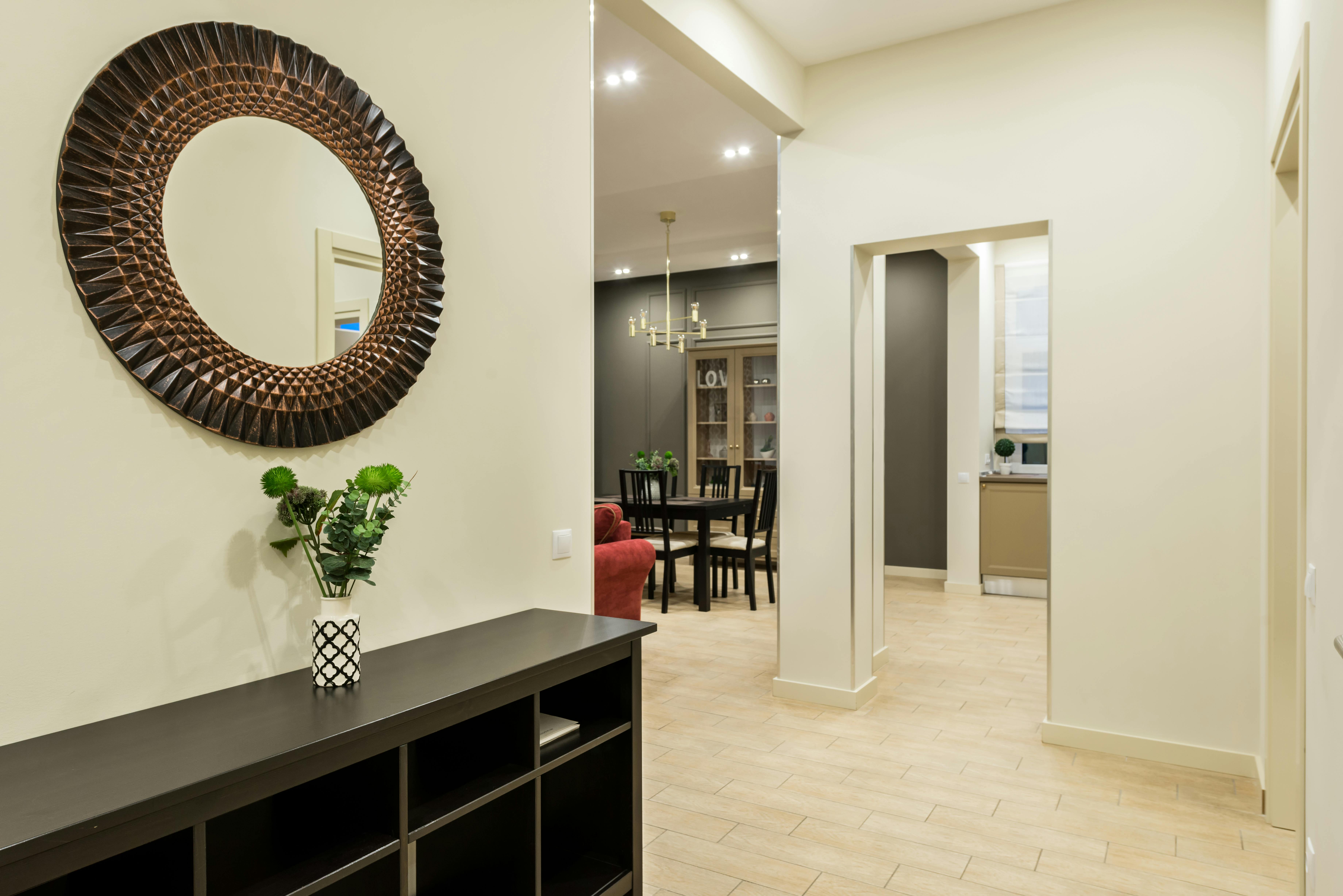
What makes a house look expensive is often less about individual products than about visual discipline. Professional stagers routinely remove excess furniture because undersized or overcrowded layouts make rooms feel less functional and less valuable. Multiple expert guides aimed at sellers and designers stress that negative space, clear walking paths and correctly scaled furniture create the impression of a larger, calmer room. That visual effect matters on listing sites, where buyers often judge room size and quality from a handful of wide-angle photos.
Lighting is another recurring factor because it changes both mood and perceived finish level. Good Housekeeping’s recent staging guidance emphasized bringing in natural light, and other current design reporting has pointed to layered lighting rather than relying only on a single overhead fixture. In practice, that usually means opening window coverings, cleaning glass, turning on lamps in darker corners and replacing mismatched or harsh bulbs with a warmer, consistent color temperature. The result is not dramatic in the renovation sense, but it makes trim, paint, flooring and furnishings appear more deliberate.
Textiles and hardware also come up repeatedly in expert advice because they add finish without requiring construction. Vogue’s staging guidance noted that window treatments can instantly make a room feel complete, especially when curtains are mounted high and wide enough to emphasize wall height. Recent design coverage has likewise pointed to tailored drapery, thoughtful cabinet or furniture hardware and textured fabrics as details that make rooms feel custom rather than generic. Stagers often translate that into neutral curtains, substantial rugs, full bedding, coordinated throw pillows and a limited mix of metal finishes.
The key is that these upgrades work best when they are edited. Overaccessorizing can make a room feel cheaper because it looks crowded and distracts from architecture or natural light. Realtor.com’s advice on keeping shelves and tabletops sparse reflects that approach, and the broader staging industry has increasingly framed the “expensive” look as one of intention: fewer objects, better placement, cleaner lines and a palette that reads calm on camera. For homeowners, that means a house can feel elevated without trying to look luxurious in an obvious way.
Why this advice is gaining traction now, and what it means for homeowners
The broader market context helps explain why professional staging advice has become more standardized. NAR’s 2025 report found that more than half of sellers’ agents, 51%, did not stage homes before listing but still recommended that sellers declutter or correct property faults. That suggests staging is not always a formal furniture-rental service; in many transactions, its core ideas are being applied as a lower-cost preparation strategy. NAR also reported a median cost of $1,500 for using a staging service, compared with $500 when a sellers’ agent handled the staging directly, which reinforces why simple, repeatable upgrades remain popular.
Industry groups are also continuing to quantify the business impact. The Real Estate Staging Association said it is collecting broader national benchmarks and reported, on its website, that its Q3 2025 highlights covered 129 homes with an average sale-to-list ratio of 109%, average days on market of 19 and an average staging investment of $3,813. RESA’s figures are industry-supplied and not a census of all home sales, but they show why stagers continue to market editing, lighting and room definition as investment-minded improvements rather than purely decorative ones.
Another factor is buyer expectation. NAR said 48% of respondents reported that buyers expected homes to look like they were staged on television, and 58% said buyers were disappointed by how homes looked compared with TV portrayals. In that environment, “expensive” often means a home meets a visual baseline created by digital listings, social media and renovation programming. The lesson for sellers is not that every home needs designer furnishings. It is that buyers now expect spaces to appear clean, bright, proportional and photo-ready.
For homeowners who simply want the look without planning to sell, the same guidance still applies. The most substantiated recommendations are consistent across national housing data and design coverage: remove clutter, clean thoroughly, let in more light, use correctly scaled rugs and curtains, and avoid filling every surface. Those are the surprisingly simple answers that keep resurfacing because they affect how a room feels immediately, and because the real estate industry’s own data shows that presentation still shapes perception in measurable ways.